
You have the people, you know who does what and you know how the profits are shared. What is missing is the thing that holds the rest together the moment somebody speaks in your name: the written rules.
Why you need written rules when everyone speaks
In an organisation where every unit takes part in the communication plan, everyone is holding a microphone. That is the strength of the model, and it is also its exposure.
The reason is that social media make the line between public and private, between official and unofficial, hard to draw: a comment about the brand, or about a competitor’s products, written from the personal profile of someone who works with you, becomes a problem for the organisation.
Hence the first rule, the one that comes before all the others: every communication activity is recognised only through the channels the parent company provides, described in the hiring plan, read and signed. Whatever sits outside those channels is not the organisation’s communication, and it is better for that to be clear beforehand, not afterwards.
Who talks to whom
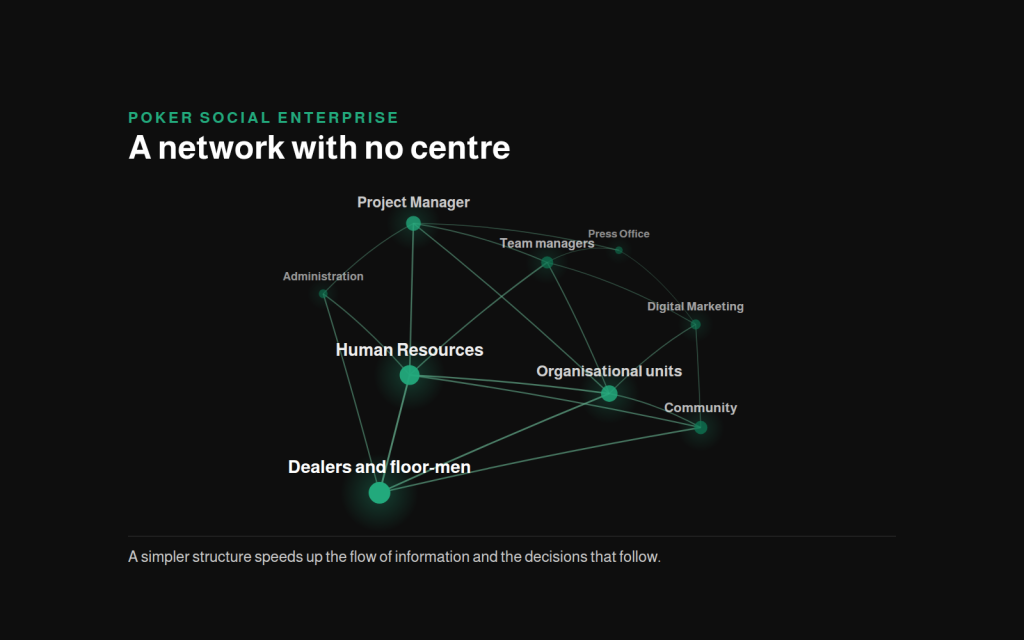
Simplifying the structure puts the project manager in direct contact with all the team managers, and that speeds up the flow of information and the decisions that depend on it. Every organisational unit has a dedicated mailbox to administration and can turn to the Human Resources Manager for anything they need.
Where the CEO and the project manager are the same person, contact runs end to end up to the top. The distinction matters: otherwise the project manager would have to know the terms of engagement of every single person on the project, and that is not his job.
The relationships that result do not draw a pyramid but a rhizome — a network with no centre, in which each node is the space that element creates with its own connections, and the connections define the kind of relationship between one node and another.
Three policies, not one
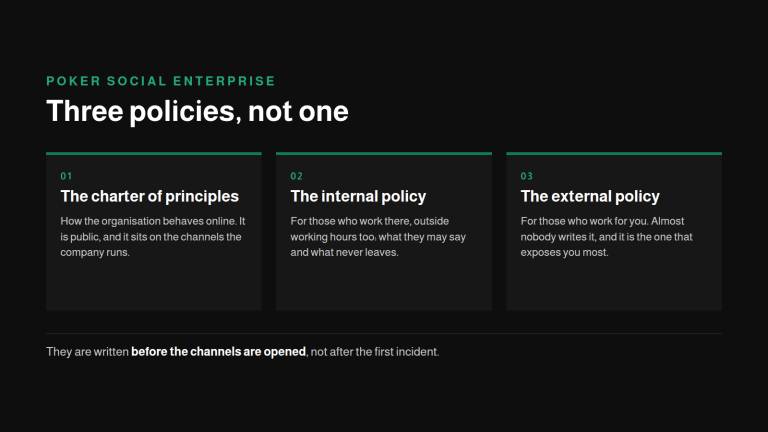
The rules to write are three distinct documents, and they serve three different audiences.
The charter of principles states how the organisation behaves online: why it is there, what it encourages, what it will not tolerate. It is the one displayed publicly on the channels the company runs.
The internal policy concerns the people who work there, outside working hours too: what they may say, what they must declare, what never leaves the building — revenues, future plans, deals still being negotiated.
The external policy concerns those who work for you: suppliers, collaborators, anyone moving online on your behalf. It is the one almost nobody writes, and it is the one that exposes you most — because a blogger approached without disclosing the professional relationship, or a rigged poll, land on your brand and not on theirs. The internal and external rules of an organisation, in full.
A crisis is measured before you react
A social media crisis is not an unpleasant comment. It is a problematic situation that starts online, or that social media amplify, until it produces negative coverage in the traditional media and losses in money or in credibility.
The difference between handling a crisis and being run over by it lies in one reflex: before answering, you measure. How damaging the content is — is it a groundless insinuation, or does it come from a real mistake? Where it is starting. Who is spreading it, and how credible they are. How it is moving from one medium to another. And how fast it is running. The five questions to ask before reacting.
The guidelines are learned beforehand, not during
By the time a crisis arrives there is no time to read anything. That is why every person must have learned the guidelines beforehand, and must be able to relate them to what they do every day.
The same goes for the team: if the criticism is legitimate, a crisis procedure is triggered with a team put together in advance, not gathered while the thing is happening. And it goes for the simplest rule of all, the one that costs nothing and saves evenings: whoever runs into a critical discussion about the organisation tells the project manager straight away.
What you actually need
Stripped down: three documents and a team. The three policies written before the channels are opened, and the people who know what to do when something catches fire.
Plus one thing no document gives you, and that has to be decided in advance: if a crisis comes from a mistake of yours, or from an over-reaction by whoever runs the community, the shortest way to put it out is to admit it and apologise. It costs less than any defence.
Rules and crises, though, are the defensive half. What tells the organisation what to produce, when and for whom, is another thing again: the editorial plan.