
Between one stop and the next, your team disappears. The dealer you trained goes back to doing something else, the floor who knew your procedures takes the first trip that comes along, and at the next stop you start over: you look, you try, you explain it all again. It is not a recruitment problem. It is that between one event and the next you have nothing to offer.
Why the team falls apart between one stop and the next
The routine of the people at your tables works like this: you work during the stop, and you sit still until the next one. No contract, no continuity, no reason to stay available to you rather than to somebody else.
Everything else follows from that. A team that is put together again every time accumulates nothing: not your procedures, not a knowledge of your players, not the way you want the table to be run. Every stop starts again from the lowest level, and the quality the audience perceives is that of people who met the day before.
A fee paid per stop binds nobody: once the stop is over, so is the reason to stay.
The skills you already have in the room
The model that makes what follows possible is called Social Enterprise, and it is worth saying straight away what it is not: it is not a social enterprise in the charitable sense, and it is not a social cooperative. It is the outcome of the evolution of organisational design in the information-automation era, and it draws on communities of practice. And there is a precise reason why it concerns you: of all organisational realities, the ones producing live poker events are the best predisposed to exploit its potential, because of how their assets are made and how the processes that design and deliver an event actually work.
The starting point is one thing organisers rarely stop to look at: the people working at your tables already know how to do other things, and they do them well, because they do them elsewhere.
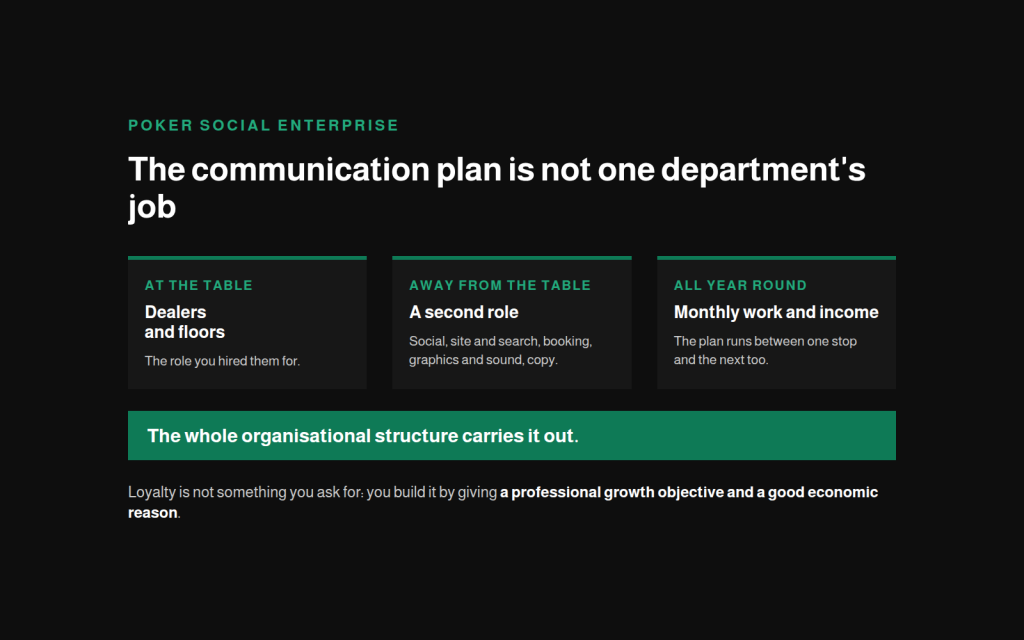
When the model was designed, the roles that hold up an event’s communication were assigned one by one to people who were already at the tables, chosen on the skills they already had: whoever runs the pages and the conversations, because they have used social media for years and know exactly how it works; whoever looks after the site and its ranking on search engines; whoever handles the booking, that is, finding the venues and selecting the best options for the players; whoever produces the graphics and the sound, because away from the table they already do editing, flyers and multimedia content; whoever writes, releases and articles, out of their own curiosity before it became a job.
They are the same people who, during the event, are at the tables. Not an outside agency receiving a brief: the organisational units that make up the working teams.
Which means those skills are not something you have to buy outside. You have to recognise them inside, and put them under contract.
Continuity: from work in stops to monthly work
This is where the Social Enterprise changes the structure of the work itself. If the people at the tables also take part in the communication plan, their work does not end with the stop: it continues through the weeks in between, because the communication plan runs all year. Work and income become monthly instead of episodic.
Look at it from your side. Someone who earns with you twelve months out of twelve is not available for somebody else’s stop — not because you forbade it, but because they already have a commitment worth more. Loyalty is not something you ask for: you build it by giving people a professional growth objective and a good economic reason.
And there is a second effect, less immediate and more lasting. People who take part in the plan are monetising what they know and who they know — their skills and their relationships. Whoever monetises their own capital inside your organisation has an interest in your organisation growing. They stop being a supplier of hours and become an active collaborator.
What really changes at the table
People who have been at the tables for years, and have worked both with amateurs and with professionals, always describe it the same way: a table of professionals only is a table that flows. The game is fast, clean and orderly, because knowledge of the rules and the procedures is taken as given and nobody has to be reminded of it. Errors go down, the atmosphere is calmer, controlling the table is easier, and the dealer team turns out more homogeneous, and therefore quicker to react.
With amateurs the opposite happens, and it is not their fault: the automatisms are missing, time is lost, rules have to be repeated, and the overall quality of the game suffers for it.
But the other side has to be said, because it is the part that concerns you as an organiser. With professionals at the table, the dealer’s preparation has to be flawless. Pros know the game in all its facets and use that to their advantage: minimum raise, the reopening of raises, the rulings that make no difference among amateurs and there make a great deal. An unprepared dealer, at that table, does not go unnoticed for a single hand. This is exactly the point where the dealer’s job changes.
In other words: raising the level of the players without raising the level of whoever deals the cards is not a saving, it is a risk.
Training is how you keep people
In the Social Enterprise the communication plan is not handed to a department: the whole organisational structure carries it out. Every unit — every dealer, every floor — joins one of the teams that produce the event’s communication, and joins it on two levels: the conceptual one, putting forward ideas and solutions, and the practical one, taking physical part in the production. Not a selected few: everyone.
Training follows from that, and it is not an extra but a necessary consequence: if you give each person a task they have never done, you have to put them in a position to do it.
In the Social Enterprise, training is not a one-off course and it is on the organisation: the company provides the internal courses through which each organisational unit acquires the knowledge and the skills for the new tasks it is given. And the assignment is not random: people are chosen on the preferences, skills and aptitudes they already had when you hired them.
Whoever takes on a path — communication, ranking, content production — learns it while doing it, inside the organisation. And the effect shows before the event even begins: some, as soon as they had chosen their role, enrolled in an outside course of their own accord, because that role made it useful.
It is the same mechanism by which a professional is really formed inside a community of practice and not in a classroom: you learn by doing, next to somebody who already does it, inside a group that has a reason to be together.
The cost, for you, is time and organisation. The return is a team that is still there next year and knows more than it does now.
What the organisation gets out of it
What the Social Enterprise leaves you, in return for the organisational work it asks of you.
The skills stay in house instead of being rented from suppliers who do not know the sector and have to be briefed from scratch every time.
The team stabilises, because it has an economic reason to stay, and with the team the procedures stabilise, and so does the quality the audience perceives.
The people working are motivated differently: they are not filling a shift, they are taking part in a result they hold a share of. Every collaborator is at the same time an active part of the project, and gets constant input rather than instructions.
The level rises by itself, because being next to people who are better raises your own bar — that goes for dealers as it goes for anyone.
Where you start
Not with job ads. You start with an inventory: who you already have at the tables, and what they can do besides dealing the cards. The list is almost always longer than you expect, because nobody has ever asked them.
Then you decide which parts of your communication can be done by them instead of bought outside, you assign the roles, and you pay for those roles — not at the end of the stop, but with the same frequency at which the work exists. It is the move from an organisation that hires stop by stop to a Social Enterprise organisation, and it does not ask you to change trade: it asks you to change structure.
For people to stay, though, a continuous payment is not enough: they need to know where the organisation they are giving twelve months a year to is actually going. That is another thing again: the mission and the vision.