
When we speak here of events conceived and designed around professional players, it means one precise thing. It is the mission and the vision behind the production of these tournaments: if you are weighing up whether this model is right for your organisation, this is where you start.
Why almost nobody writes them
If you run an organisation producing live tournaments, in all likelihood you communicate without an editorial plan stating what your mission and your vision are. That is not carelessness on your part: it is the consequence of how you are structured. A vertical, centralised chain of command, a strategy built on cost leadership, attention entirely on the offer in order to maximise profits. With that structure you do not look at the processes that measure your organisation’s effectiveness — governance and policy included — because you have nowhere to put them.
And that is also where the way you compete comes from. You build appeal on the minimum guaranteed prize pool, like everyone else, and the commercial war is always fought over the same formula: the biggest prize pool at the lowest possible buy-in. A race won by whoever has the deepest pockets.
In recent years something has moved: some have begun to step away from the prize pool and to bet on the value of the play structure, promising longer and more satisfying experiences. It is the right direction. This mission takes it all the way.
The mission
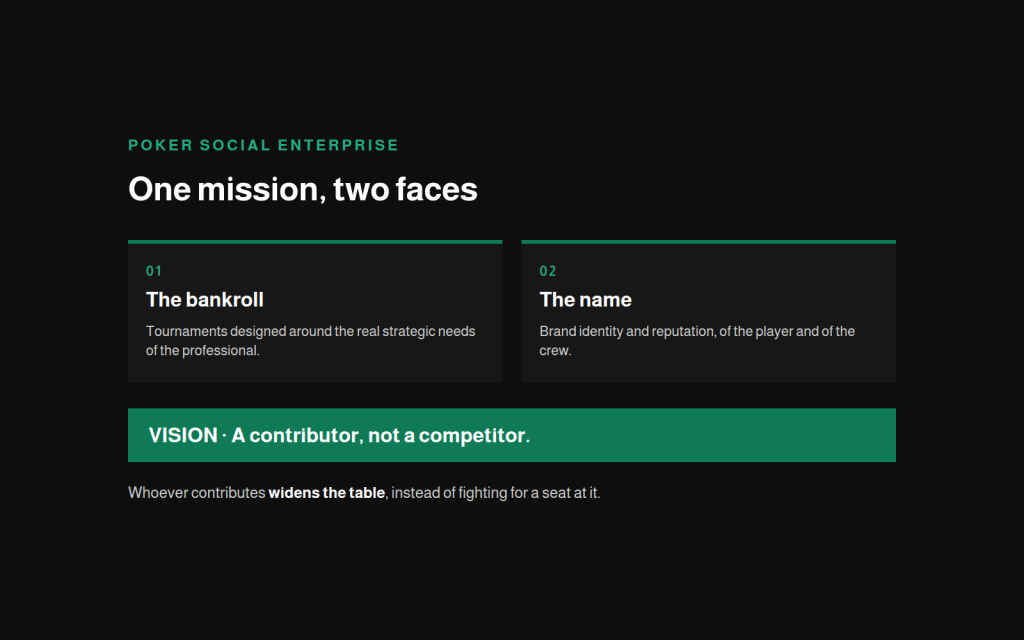
The production of live Texas Hold’em poker tournaments conceived and designed to satisfy the real bankroll strategy needs of every professional player, and the Brand Identity and Brand Reputation needs, at individual and collective level — the poker crews — of those same professional players.
It is not a line written with a fresh mind: it is the result of applying the Communicative Business Model Canvas, the tool with which you line up key partners, activities and resources, value propositions, relationships and channels, and from which you draw your critical success factors.
How you meet it, in practice. The bankroll need with a large daily tournament schedule, inside meetings running from a minimum of eight days to a maximum of three weeks, depending on what the casino hosting you can offer: not an isolated date, but a window inside which the professional can organise their own work. The brand needs with a central Main Event, which leads to a strategic route into the outside events offered among the big majors on the market.
The digital communication department supports the editorial strategies and the brand management. And you do not hand it to an outside supplier: communication is produced by the same organisational units that work your event, because whoever promises something to the players has to be the one who delivers it.
The vision
The sector you work in has reached a reset. Recognised professionals left the career after travel stopped, and before that the precariousness of the legal position — made worse by the absolute ban on gambling advertising across all media — had already driven away the interest of the stakeholders and with it every prospect of investment and development. There is only one way out of a reset: defining an economic model able to satisfy the needs and the expectations of all the stakeholders.
Hence the vision: to be perceived by all stakeholders as a new contributor, not as a new competitor. You come in to promote poker from a cultural point of view and to feed the whole economic sector for the benefit of those same stakeholders, not to take a share of entries away from another organiser.
And inside the sector there are the people who make it work for you. The most mortified category is the organisational unit with the dealer’s role: treated by management as a mere accessory, with the resulting absence of the minimum requirements of professionalism, in an unregulated sector that diminishes the identity and the value of the role itself. It still happens today, at events with buy-ins up to a thousand euro, to find at the table somebody who barely knows the ranking of the hands — and you are the one paying for that table. Improving the working conditions of the people who produce your events is part of the vision, not a welcome side effect: the benefit is shared, by you who organise, by whoever works there and by whoever plays.
What you get out of it
It is not a statement of intent. These are advantages you can measure.
Control, innovation and efficiency stop being a problem of hierarchy. With management and analysis software you monitor the activity of all the staff and measure performance in real time. What a traditional structure achieves by adding layers of command, you achieve with data — and efficiency, traditionally measured by the success of the individual event, stops depending on how the last stop went.
You know who is in front of you. Fully digital gaming tables give you a considerable competitive advantage, because they let you know the profile of your own customers in terms of tastes, preferences and trends. It is data you buy from nobody: it is generated by playing.
Line functions give way to working teams. You drastically cut the hierarchical barriers, and redistributing responsibility amounts to redistributing profits. You do not appoint the teams from above: they form by recruiting the organisational units that expressed an interest in that role.
The press office is in house. Unlike many operations in the sector, being able to count on journalistic services of the highest professional standard is a formidable competitive advantage: releases, investigations and content are produced in house, on your editorial plan’s schedule, and to whoever wants to follow it you open a real journalistic career.
The value is not the entry
There is a point where mission and vision stop being two words on a website and become the way you make money.
Value does not lie in the simple conversion of interest into purchase — the entry taken — but in the continuity of that relationship, founded on the mutual trust and respect that binds you to whoever takes part, and expressed in the sharing of the values you have declared.
Which is to say: mission and vision are not there to get you chosen once. They are there to get you chosen again.
Where the offer comes from
From this position come the consultancies for opening or relaunching a poker room wherever the game is legally recognised.
Mission and vision are for this: knowing what you are offering, before you offer it. If you are thinking of opening or relaunching a club in your area, that is where the conversation becomes practical.