
The communication of a poker club is, in the vast majority of cases, improvised: people start talking about the stop when the date is close, and stop the day after. In this model nothing is improvised: twelve months are planned, and every stop of the year sits inside a single plan.
Why team events never took hold
Collective competitive experiences in live poker have existed before. They found no fertile ground, and the reason is not the format: they were structured according to the business and marketing strategies typical of individual events.
A team event asks for something else. It asks you to look at the mission of the teams taking part and to orient your business and communication strategies around it. It is an approach that is more qualitative than quantitative — and this, in all likelihood, is the condition that kept this kind of event from developing.
In practical terms: announcing a tournament and waiting for entries is not enough. You need to know why a team should want to be there, and build a year of communication on top of that.
Before the editorial plan comes the tool
An editorial plan is not written with a fresh mind in front of a blank page. It comes after strategic planning, and that planning has a tool: the Communicative Business Model Canvas.
It serves to formalise the critical success factors and, on that basis, to define a correct communicative positioning on the company’s digital channels. In a single table it lines up the key partners, the key activities, the resources — tangible and intangible — the value propositions, the customer relationships and the channels they travel on.
It is a chapter of its own, and it is the chapter everything else follows from: once the strategic assets are defined and the critical success factors identified, it is those that guide the editorial plan. Here we stop at the fact that it exists and that it comes first.
Who exactly are you talking to
The second thing that comes before the calendar is knowing who reads. Not “the players”: one precise person, with a profile written out in full.
In the case of a high-level team event that person is a professional who belongs to a crew. He travels a great deal for live stops, invests in innovation, keeps himself constantly up to date. He is highly educated, looks for originality and exclusivity, and chooses events with the best ratio of hands played to time. He lives on social media and messaging apps, and the last time he sat at a live table it was at a high-level tournament.
What he wants splits in two, and the two must be kept apart because they are communicated differently.
The rational benefit: growing his own bankroll, and giving his team global visibility — visibility that then ties back into the team’s own teaching and commercial activities. Plus the ability to analyse the event afterwards, accessing the data of his own sessions and reviewing the hands he played.
The emotional benefit: feeling part of a cultural shift in the way the discipline is perceived and understood — and of the economic and cultural opportunities that shift opens up.
And then there are the two objections you will actually hear, which belong in the plan before anyone says them out loud: the buy-in is prohibitive, and I am not part of any crew. An editorial plan that does not answer those two is talking to itself.
Twelve months planned, not a week of announcements
The communication plan covers twelve months, and inside those twelve months sit all the stops of the year: not one plan per stop, but a single plan that holds them. In the first year it is built on desk analysis alone; field analysis is folded in from the following year, when the data exist.
The first campaign has two objectives, in this order: awareness and appeal. That is, reaching the greatest possible number of people interested in the themes the plan puts forward, and then winning their interest.
Which means that for the first months you are not selling anything. You are giving all the information needed to understand the values the event is built on, and promoting the innovations that set it apart. The selling comes later, when there is somebody who has understood.
What goes out, week by week
An editorial plan is not a list of good intentions: it is a calendar in which every week has a piece of content and someone responsible for it. The rhythm, in this model, is made of a few things that keep coming back.
An article answering frequently asked questions, every week, on a fixed day. It is the backbone: fifty-two weeks, fifty-two chances to answer a real question somebody has actually asked.
Live interviews with the guests, scheduled with a fixed weekly appointment, each tied to the contribution that person brings to the event — and planned with time zones in mind, because the audience is not all in the same room.
The releases and articles sent to the press and to stakeholders, which are a channel in their own right and not a repost of what is already on the site.
The formats devoted to the teams, built from different points of view — cultural, social, economic, empirical — and the formats for the selected influencers, with their own periodicity.
The internal contests, which involve the people working on the event and close with an award during the event itself.
And before every block of content, a video briefing to define its themes. Nothing is produced that has not been decided together.
Every week has a name beside it
This is the detail that turns a calendar into a working plan. Beside every week, in the model, it says who answers for that content: the press office, the account manager, whoever coordinates the staff, the external support — often more than one, because almost no piece of content belongs to one person alone.
And there is a principle that ties this chapter to all the previous ones: the formats are not produced by an agency, they are developed by the organisational units that make up the working teams of each single project. The same people who are at the tables during the event.
This is where the model closes on itself. The horizontal structure was there to make information circulate; taking part in the communication plan was there to give continuity to the work; the written rules were there to protect whoever speaks. The editorial plan is the place where all three become concrete work, week after week, for a year.
Where you start, if you start
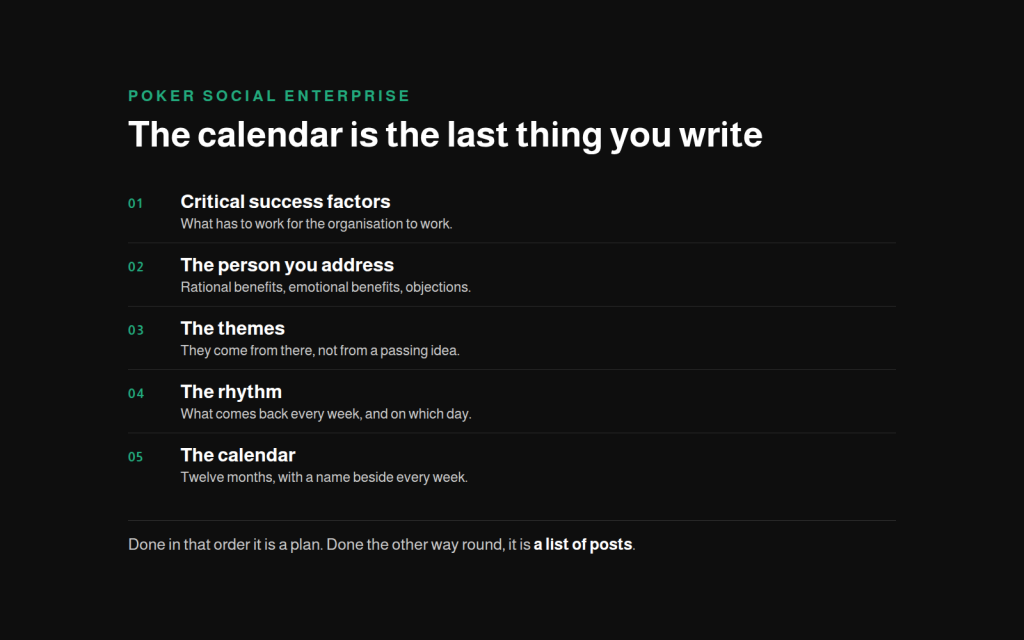
Not from the calendar. The calendar is the last thing you write.
You start from the critical success factors — what has to work for the event to work — and from the profile of the person you want to talk to, with their rational benefits, their emotional benefits and their objections. From there come the themes; from the themes comes the rhythm; from the rhythm comes the calendar, with the names beside it.
Done in that order, a year of communication is a plan. Done the other way round, it is a list of posts.
Somebody, though, has to carry the plan out — and it is not a department: it is the whole organisation. The next step is keeping the people who do it.