
If you run a legal Texas Hold’em poker club, or you are thinking of opening one, what will stop you is not the prize pool. It is the structure you run it with.
How a poker room is organised today
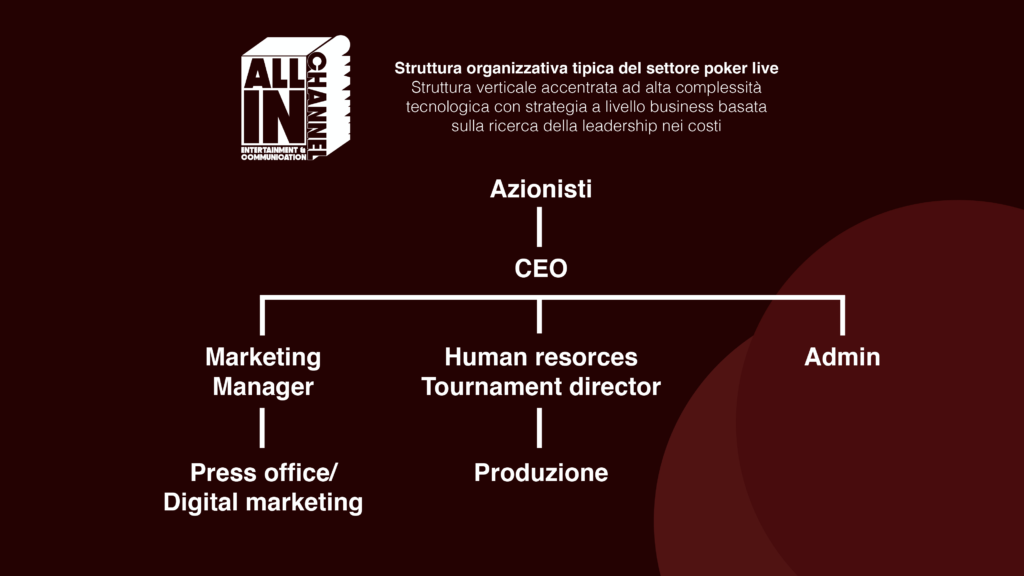
The structure you will be offered is always the same: a vertical chain of command, decision-making power centralised at the top, functions split by competence and each one reporting to a superior. It is the classic capitalist paradigm, and in live poker it is so widespread that it looks like the only one available. What the organisation of a poker room is really made of.
It has its own logic: maximise profit by working on the offer. But it drags along a consequence almost nobody accounts for. An organisation built this way cannot measure its own effectiveness, because it has no process for doing so — neither on governance nor on policy. It looks at the takings of the night and calls that efficiency.
The rest is done by the rigidity of roles: decision-making slows down, position lends itself to abuse, and the search for quality slips to the bottom of the list.
And this is the root, not a detail: that structure was born before digital, and it cannot answer what digital demands. A vertical chain holds up when information is scarce, slow, and climbs one step at a time. In the information era, the information about your event arrives from every direction at once, and it asks for decisions taken where things happen, not three levels above. Organisational design evolved because it had to, and tearing down hierarchical barriers by delegating decision-making is not a concession: it is the condition for keeping up.
The role this structure penalises most is the dealer
There is one figure this structure penalises more than any other, and it is the one the night rests on. Management treats the dealer as an accessory from whom no particular professionalism is required, and gets exactly what it asked for: the absence of minimum requirements of competence.
This is not an impression. In thirteen years of observing the sector, at events with buy-ins up to a thousand euros, you can still find at the table a dealer who barely knows the ranking of the hands, or who between one street and the next drifts into his own thoughts until a player, with visible limits of tolerance, brings him back to the reason he is there.
And it is not only about dealers: even roles with evident technical qualities show a very low degree of professionalism. The cause is upstream. It is the lack of regulation in the sector that empties out the identity and the value of the organisational role, and that erodes even the way those who hold it see themselves as professionals.
The prize pool war
If efficiency is measured by the success of the event, the only lever left is the prize pool. For years the winning formula has been the biggest prize pool at the lowest possible buy-in, and it produced a real commercial war. The yardstick the sector uses to measure its own success.
It is a race you win only until someone offers more. Then it starts again, on thinner margins.
Something is moving, though: people are beginning to think in terms of a mission that looks at the depth of the game structure rather than the prize, and to promise the player a longer and more satisfying experience at the table. It is a change of promise, and whoever makes it first in his area keeps it.
Why the professionals left the sector
The legal position of those who produce live poker events is precarious, and the Dignity Decree made it heavier by banning gambling advertising: with that ban, every prospect of investment in the sector vanished.
But the harshest effect of the lack of regulation is not about investment. It is about people.
In a regulated sector, when work stops, category protections exist: the category is recognised, and emergency measures reach those who belong to it. In live poker that recognition does not exist. And when the work stopped, dealers and floor-men of the highest professional level left the business for good, because there was no legal recognition giving them access to the state emergency measures for their category.
They did not leave by choice. They left because, at the moment it mattered, as far as the State was concerned that work did not exist.
Those people are what you need today, and to a large extent they are gone. It is the bill that the precariousness of the sector hands to whoever organises it — and it hands it to you the day you have to put a staff together.
Communicating without an editorial plan
The success of events, before everything stopped, did not come from the quality of the organisational models: it came from the scarcity of supply. On one side the professional who needs to compete, on the other the amateur who needs to enjoy himself. Being there was enough.
Today it is not enough any more, and what emerges is the need for a clear editorial plan stating the mission and vision of the brand. Not a social profile updated when there is time: a brand identity and brand equity strategy, aimed at involving your audience and sharing values, interests and goals with it.
Because value is not the conversion of interest into purchase. Value is the continuity of the relationship — loyalty — and it rests on mutual trust and respect between the brand and whoever chooses it.
Where you start from
The problem is not your room and it is not your prize pool. It is that you are running a business of today inside a structure designed for another era.
The Social Enterprise Model is the result of the natural evolution of organisational design in the information era. It is not a management fashion and it is not a correction to the org chart: it is the shape an organisation takes when it stops being a pyramid and becomes a network, because that is how you answer needs a pyramid cannot even see.
The way live Texas Hold’em tournaments are organised is bound to change radically, and what changes it is this model.
The Poker Social Enterprise starts from how people actually work together — from communities of practice, and from the principle that complete knowledge never belongs to a single person. From that principle comes the case the model was tested on: Champions Crew, a live team tournament designed for poker Crews. What the Social Enterprise Model is, and what it is not.