
You have decided what to replace the pyramid with. What remains is the practical question, the one that hits you the day you have to put a team together: who do you actually need, and what does each of them do.
A manager who takes barriers down instead of putting them up
The structure that holds up an event built this way is horizontal, decentralised and data driven, and it competes on differentiation rather than on price.
The starting point is a single sentence, and it is worth reading twice: just as the internet and digital technologies brought down the barriers of space and time, in the same way a manager must bring down the hierarchical barriers inside the organisation and encourage decentralisation, delegating decision-making responsibility.
It is not an invitation to go soft. It is the recognition that a vertical structure does not answer digital needs: the Social Enterprise is the natural evolution of organisational design in the digital era.
What it rests on: four things, not an org chart
The organisational asset of this model is made of four elements:
- a project manager with distinctive skills in the digital field;
- the team managers with their own teams;
- the management-analysis software tools;
- fully digital gaming tables.
The last are the ones that make the competitive difference, because they let you know the profile of your own customers in terms of tastes, preferences and trends — something no cash sheet will ever tell you. The organisational asset of a poker room, its four elements and who leads them.
And here an account left open at the start of this series is settled. The problems of control, innovation and efficiency that make the traditional structure blind find their solution in tools that monitor the activity of all the staff and measure performance in real time. The vertical structure could not measure itself: this one knows what to measure itself with.
The project manager, and why he should also be the CEO
The project manager is the brain of every project: it is in his mind that value is born in the form of an idea, and he is the only one who knows every organisational and strategic detail of it. He designs the new tournament formats, the communication plans and the editorial plans that go with those events.
This is why selecting this figure is the most delicate decision you will make. And if the organisation stays oriented to producing digital-driven live events only, it is advisable to make the project manager and the CEO the same person: distinctive digital communication skills develop, the most suitable people are selected from within, and the products stay coherent editorially. The ideal PM, in that case, is a digital marketer with strong content strategist skills.
The three roles that hold the event up
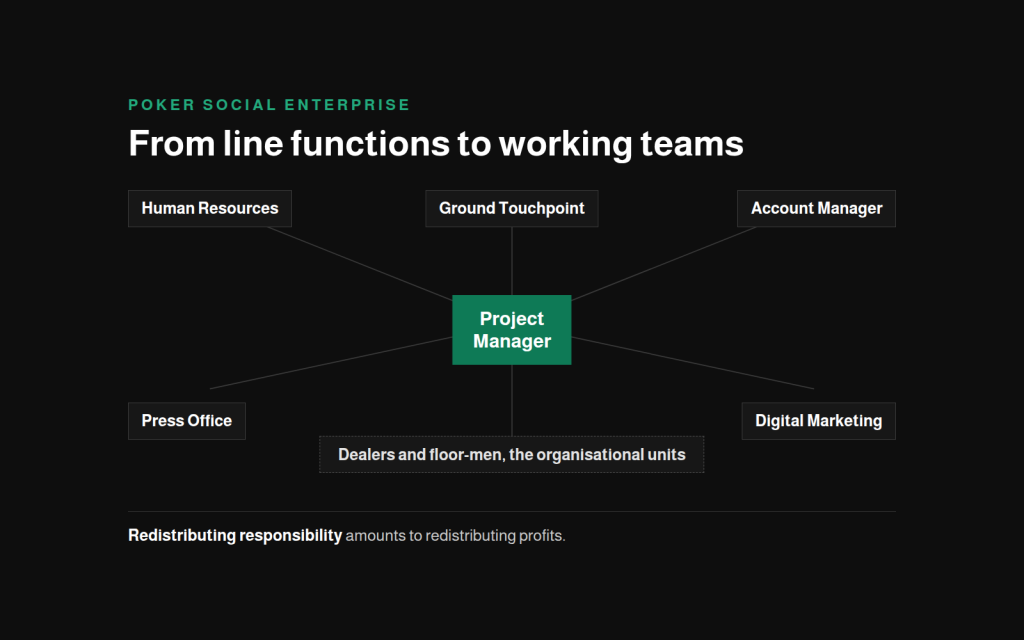
Human Resources Manager. This is the role traditionally associated with the tournament director, and in this model it absorbs it. He reports directly to the project manager, designs the tournament structure with him and organises the units that will deliver it; he handles relations with the staff and answers their requests, reporting back to the PM. The tournament director, where needed, stays on as a “guest star”.
Ground Touchpoint Manager. He handles the acquisition of venues, at home and abroad: he chooses the best ones for the type of event in complete autonomy, identifies the facilities for guests’ food and accommodation, and coordinates the booking during the conversion phase. When needed he negotiates in person and acts as interpreter on documents and face to face.
Account Manager. He watches over the online conversations, spots the issues that could damage the editorial or business objectives, has the authority to remove irrelevant or offensive comments, and acts as moderator when a discussion heats up, referring people to customer care. The tournament director and the three roles, in full.
All three, when the work grows, ask the HRM for people among those who have declared an interest in helping out. You do not hire: you compose.
And it is here that the model shows its economic consequence: reducing hierarchical barriers means redistributing responsibility, and redistributing responsibility amounts to redistributing profits, replacing line functions with real working teams.
Who communicates: press office and cockpit
The Press Office Manager runs the press office: he drafts and sends the releases to every stakeholder, organises the journalistic output according to the editorial plan and guarantees the deadlines. With the project manager he designs and produces the investigative pieces. And in agreement with the management of the commissioning publishing house, where there is real interest it is possible to start a high-level professional training path towards a career in journalism.
The digital marketing team is the project manager’s own: it is the cockpit that, through the communication plan, process after process, steers the organisation towards its business objectives.
Who is at the tables: the dealer becomes a referee
The organisational units are the dealers and the floor-men, and they keep the tasks they have always had. During the event it is the HRM who coordinates the whole staff: he assigns each person’s starting position and sets the turn over — the move to the next table every thirty minutes — to guarantee transparency and regularity of play.
Then comes the difference that counts. The dealer does not deal the pocket cards and does not lay the board: the software installed on the table does. And it is the opposite of a demotion: what is left is the harder job. The dealer becomes a real referee of the game — full concentration on what happens at the table, guiding the players’ action, monitoring and calling the turns, checking that the digital felt behaves as it should and stepping in at once when it does not.
The floor-man keeps his function: he watches the tables in his charge, steps in at the dealer’s request when behaviour turns rude, and when an opponent calls the clock he sets the last sixty seconds to decide. In the process of regulating the discipline, his professionalisation is the same as the dealer’s: that of a referee. The poker dealer when the cards are dealt by the software.
The specialisations that open up to those already at the tables
The principle is simple: the role is the role it is in any company. The model does not reinvent it — it brings the dealer inside it. Whoever works at the table finds a path to professionalisation through a specialisation, and puts it to work alongside his job.
Booking operator — works alongside the Ground Touchpoint Manager in organising and coordinating the guest booking, bringing his own soft skills to it.
Webmaster and SEO manager — looks after the circuit’s website and its ranking: structure, publishing, search. It is the role that makes the event exist outside the room as well, on the days the room is closed.
Graphic and Sound designer — produces the circuit’s graphic content and jingles: posters, event materials, the sound identity of the coverage.
Dealer in Research and Development — watches the trends of the sector and draws new operating scenarios from them: how the game changes, how the players change, what the circuit will have to be able to do to keep up. For a dealer the path is a natural one: at the table those changes are visible while they happen, not afterwards.
Social listening — whoever has an aptitude for listening joins the account manager’s team and filters the conversations.
To acquire the skills the new tasks require, the company provides internal training courses.
And active participation in the communication plan is not volunteering: it is rewarded on top of the role at the tables. How, exactly, is the next thing to look at.