
You have a horizontal structure and you know who does what. What remains is the question that decides whether it holds: what do you pay the people who work in it with — and why should they stay with you instead of going to somebody else’s tournament.
Engagement is not only about the audience
When business strategies with engagement objectives are discussed in live poker, everyone thinks of the players. But in the live poker sector engagement does not concern only the users and the potential audience. It concerns, before them, the people who produce the event.
It is a change of addressee with an immediate practical consequence: an organisational model of this kind requires the active employment of every unit hired for the event, and that is anything but a given.
What happens today outside the days of the event
Look at how it works now, in your room and in every other one. Dealers and floor-men are actively employed only on the actual days of the event. Throughout the communication campaign — that is, the months in which the event is built and sold — their role is passive, or none at all.
They are the people who know the players better than anyone else in your organisation, and for eleven months out of twelve you are not using them. It is not a question of generosity: it is productive capacity standing still.
Twelve months of plan, not four days of tournament
The communication plan the model was built on runs for twelve months, and it produces an amount of editorial content that needs the active contribution of every organisational unit.
Whoever is at the tables is selected — on the strength of the skills and aptitudes that led to their hiring — to join one of the production teams. And for the new functions the company provides internal training courses: nobody is asked to improvise a trade they do not have.
Three separate items, not a salary
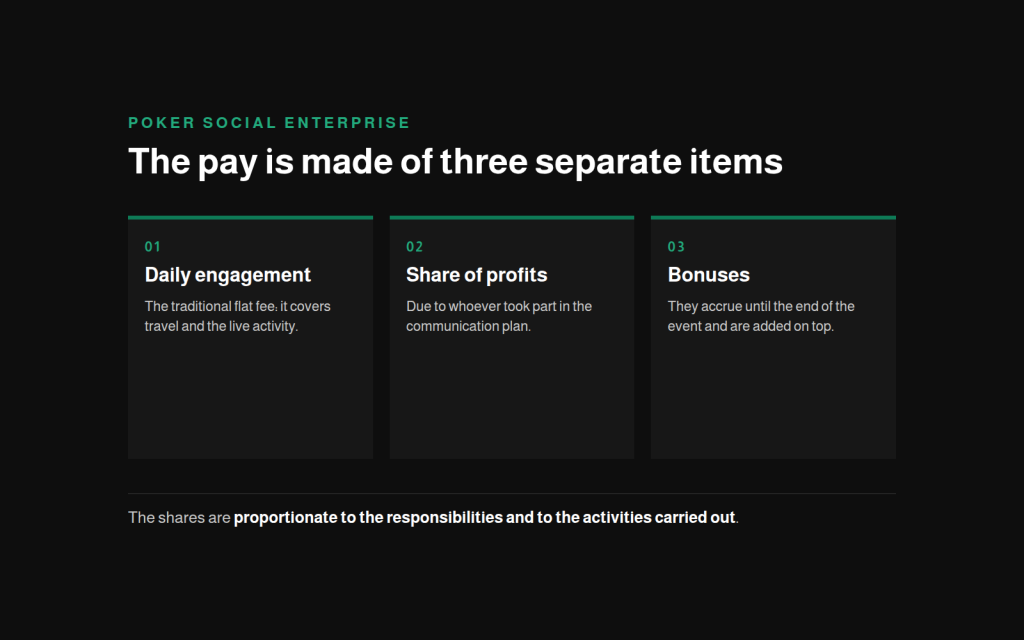
Here is the mechanism, and it is simpler than it is usually made to sound. Whoever works on the event receives three distinct things:
- the daily engagement, the traditional flat fee, covering travel and the live activity;
- a share of the net profits accrued during the event, due to whoever took part in the communication plan;
- the bonuses, accumulated until the end of the event, added to what has already accrued.
The shares are not the same for everyone: they are proportionate to the responsibilities and to the activities actually carried out. And they add up — for every activity a person takes on inside the communication plan their share grows, cumulatively. Whoever contributes more receives more, without anyone having to move up a rank. How the redistribution of profits is structured.
For you who organise, the arithmetic is different from how it looks: that share comes out of the profits, not out of the fixed costs. If the event goes well you pay it; if it does not, it is not there.
Before being a manager you are an organisational unit
This is the sentence that turns the pyramid over, and the one that anyone coming from a vertical structure finds hardest to accept.
The model turns every traditional figure of command into a guide of their own team. The manager is not the one who hands out the work and waits: he is the first organisational figure immersed in the production processes of his own department, and he asks the units on stand by for help only at the point where he can no longer handle his own activities alone.
From this follows the part that surprises people: the manager is also owed the base share that every organisational unit is owed. Not as a manager — as someone who produces. Before being a manager you are an organisational unit, and as such you are entitled to the base unit share. What an organisational unit receives.
The project manager is a separate matter
The only exception is the project manager, for the reason you have already seen: he is the brain of the project, and the communication plan is his. To the share he is owed is added the rate corresponding to every activity assigned to the plan, because every activity goes through him anyway.
What all this buys you
It is not philanthropy, and it is worth saying so plainly. A profit sharing plan does three things no pay rise does: it keeps people attached to the result of the event, because their compensation is tied to it; it keeps them active for twelve months instead of four days; and it keeps them with you, in a sector the best professionals walked out of because nobody builds a life on a job that exists four days a month.
An organisation where everyone takes part and everyone takes a share, though, needs written rules — on what gets done, on how it is said, and on what happens when something goes wrong. That is the next thing to look at.