
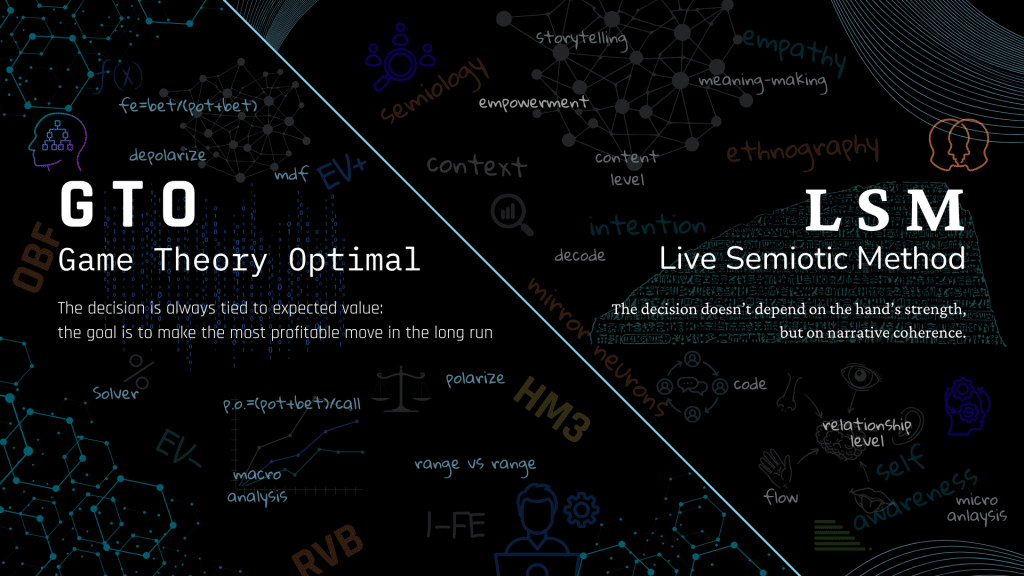
Throughout his academic and professional journey, Pietro Semeraro has brought together two seemingly distant worlds: poker strategy and communication sciences. While many players rely on the GTO (Game Theory Optimal) model, Pietro developed the idea that in live poker, semiotic analysis and ethnographic observation can offer a superior competitive edge.
“GTO,” Semeraro explains, “is an extremely solid system in online contexts, but in live tournaments I clearly perceived its limitations. When human signals become central, you need a different lens.”
GTO: The Perfect (but Blind) Logic
Game Theory Optimal is based on mathematical models aimed at creating an unexploitable strategy. Against a perfect opponent, GTO guarantees at least a break-even result. However, this very perfection is also its limit:
- Its theoretical rigidity makes it ill-suited for environments dominated by human unpredictability, such as live poker.
- It does not read behavior. It ignores:
- tone of voice
- posture
- hesitation
- implicit messages and communicative intentions
- effects of communication
- storytelling
- narrative inconsistencies, just to name a few.
- GTO is effective against everyone, but it expresses its full defensive value against strong or unknown opponents. To exploit opponents’ leaks, adaptation beyond GTO is required.
“In live poker, GTO misses the nuances—it only interprets actions as numbers. I want to read the intention, behind that action.”
The Semiotic-Ethnographic Method: A New Epistemology for Live Poker
Starting from the foundations of semiotics, Pietro Semeraro developed a dynamic and contextual methodology for reading gameplay. A method articulated in four phases, each corresponding to a Texas Hold’em street:
Pre-Flop – Opponent Classification
- This goes beyond standard labels (tight, loose, passive…). It’s about behavioral profiles built from visual, paraverbal, and rhythmic cues.
- “True reading begins before the cards are even dealt.”
Flop – Semantic Range Narrowing
- Focus shifts to the meaning behind behavioral sequences: what narrative is the opponent trying to build?
- “I don’t eliminate combinations—I assess whether the flop strengthens or weakens their story.”
Turn – Situation Definition
- Through ethnographic analysis and the process of semiosis or meaning-making, one can determine the competitive/communicative situation: it’s the phase where the story takes form.
- “The turn marks the end of strategic planning. Whether the story began on the flop or unfolds now, this is where intentions become structurally clear.”
River – Confirmation or Correction
- The final street validates or disproves the narrative. It completes the interpretive cycle.
- “My final call, fold or any raise doesn’t depend on the absolute strength of my hand, but on the coherence of the narrative.”
| Aspect | GTO | LSM |
| Optimal Context | Online, against strong opponents, without info | Live, where the communicative context is observable |
| Foundation | Mathematics and balance | Semiotics and ethnography |
| Flexibility | Limited | Maximum |
| Requires Support Software | Yes | No |
| Adaptability | Low | Very high |
| Risk of Exploit by Opponents | Reduced | Variable, but manageable with experience |
Conclusion
With his epistemological model, Pietro Semeraro has outlined a new path for those who play live and want to go beyond mere statistical application. It’s an analytical yet intuitive approach. Technical yet human. Capable of restoring poker’s psychological and communicative dimension that GTO alone cannot capture.
“Playing well doesn’t just mean making the correct decision—it means understanding the deeper context that makes it correct.
My method doesn’t oppose math—it integrates it. It offers an interpretive map of the poker table, enhancing the ability to read opponents and the situational meaning of actions.
Live poker isn’t just math—it’s a language to decode.
And to master that language, you need semiotic, ethnographic, and strategic skills. It’s not about guessing—it’s about knowing what to observe, who, where, when, and why.